Home / Where we work / Folsom
Folsom junk removal when the free pickups are used up or not a fit
Folsom residents get 3 free bulky pickups a year. Reliable Junk Removal serves Folsom for everything those pickups are not built for: items still inside, heavy pieces that must be taken apart and jobs that cannot wait.
Book online, and we will give you a call shortly.
Folsom's 3 free bulky pickups
The City of Folsom gives residents 3 free bulky pickups a year (as read 4 September 2026). That is a good deal for a pile you can set out and wait on. Check the city's page for current rules on what goes in the pile and how to schedule it.
Get it gone
Send a photo or book online. We confirm the price before we lift anything, then load, haul and sweep up.
What a curbside pickup is not built for
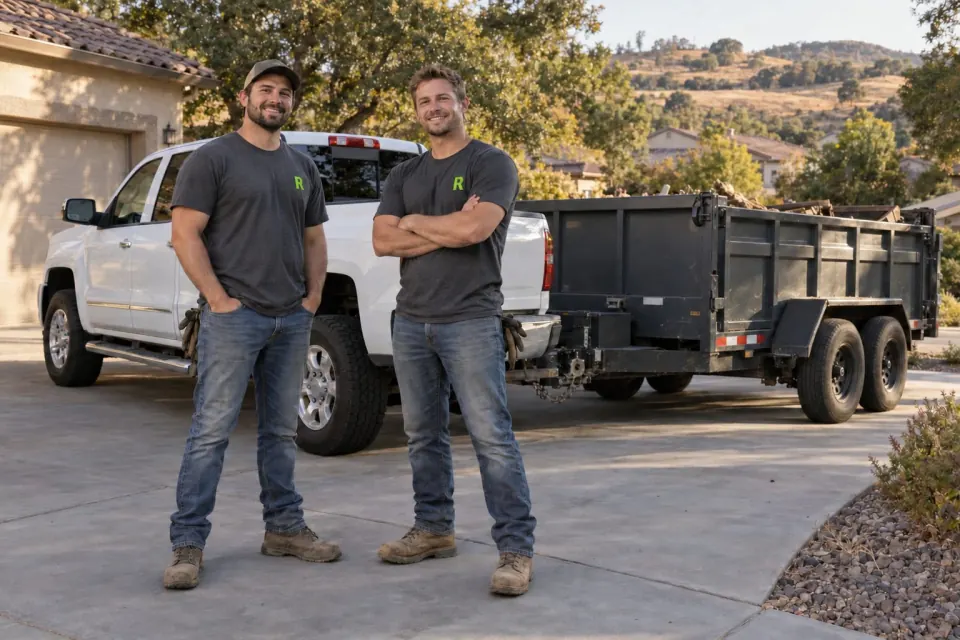
Whatever the city accepts, a curbside pickup collects a pile someone has already carried out. That leaves a lot of jobs it cannot help with:
- Furniture still upstairs or in a back bedroom, with nobody able to carry it down
- A hot tub, piano, safe or shed that has to be taken apart or moved with care
- A whole-house clear-out before a sale or a move
- Landscape clearing that needs hand tools or heavy equipment
- A fourth load in the same year
- A deadline that will not wait for a pickup date
Those are the jobs we do. A crew of two carries from any room, protects floors and door frames on the way out, and takes apart beds, play sets and hot tubs as part of the job.
Junk removal in Folsom, service by service
- Hot tubs, pianos and heavy items, including piano removal and safe removal
- Residential junk removal for rooms, garages and attics
- Cleanouts and life events: estates, move-outs and downsizing
- Landscape clearing and green waste, light duty or heavy duty
- Light demolition of sheds and decks
- Furniture and mattress removal
- Moving service for the things that go with you
Where a Folsom load goes
Donate. Recycle. Dump. It is the order we work in. Anything with life left goes to donation (the local partner you prefer, agreed at the on-site estimate), metal goes to scrap, e-waste goes to an e-waste recycler, branches go to green waste composting and cardboard goes to recycling. Only what is left goes to a transfer station or landfill.
Folsom is in Sacramento County. If you are taking some of it yourself, Kiefer Landfill in Sloughhouse takes mattresses free from non-business customers (as read 4 September 2026), and North Area Recovery Station in North Highlands allows non-residents (confirmed 29 September 2026); check access first, as a construction notice is posted. We'll haul anything but paint and solvents, fuel and oil, chemicals and pesticides, propane tanks, asbestos, medical waste and ammunition; we tell you where those go instead.
Kiefer Landfill, Sloughhouse: Mon to Fri 6:30 to 4:30, Sat and Sun 8:30 to 4:30 (as read 4 September 2026). North Area Recovery Station, North Highlands: Mon to Fri 6:30 to 6, Sat and Sun 8 to 6 (confirmed 29 September 2026).
Hours and access change: confirm with Sacramento County.
What it costs in Folsom
We price by the space your items take on the truck. An upright piano takes about 70 cubic feet, a hot tub about 300 and a pool table (not slate) about 40. A heavy single item starts at single-item price: to confirm. Labor, loading, hauling and disposal are all included, and we confirm the price before we lift anything. Use the calculator or see heavy item pricing.
Book online, and we will give you a call shortly. Text photos to (888) 450-4097 for the quickest price.
Other cities we serve
Questions people ask
How many free bulky pickups does Folsom give?
Three a year for residents (as read 4 September 2026). Check the city's page for current rules before you set anything out.
Can you get a piano out of a Folsom home?
Yes. We protect the floors and door frames, move it out with care and haul it away. See piano removal.
Can you come on a Sunday?
Yes. We work 7 am to 7 pm, 7 days a week, and a visit is often within a day or two of booking.
Do you donate furniture?
Yes, when it has life left. Donation comes first, then recycling, and only the rest goes to a transfer station or landfill.